Archive | Recipes RSS feed for this section

Artichokes or Fartichokes? We Test Them

7 Nov

I got a quart of Jerusalem artichokes (Helianthus tuberosus),as a special bonus from the farm the other day and I was thrilled to get to try them.

Here's what they look like before washing

Here’s what they look like before washing

But a funny thing happened when I began to research…some articles suggested that as delicious as these roots are — favored by Native Americans back in the day and now beloved worldwide — and despite their cheery aliases —  sunchokes, sunroot and earth apples  — they have a dark underbelly. Emphasis on belly. The story goes that they cause gastric disturbances that no one wants to talk about, since they have so many tasty uses and currently are the darling of the foodie-rootsy set.

I took my investigation international, as my sources said the Brits in particular complained about the gas and christened them “fartichokes.” Given that the English would be unlikely to worry about the truth of such a terrific pun-type word and would happily use it with complete disregard to its relationship to actual fact, I had to corroborate.

Cleaned-up Jerusalem artichokes.

Cleaned-up Jerusalem artichokes.

My son and I got on the Skype to Lowestoft, England to ask my friend Kate and her two boys, Alastair and Gregor, who are 10 and therefore can be expected to be well-versed in anything gassy. They said no, they’d never heard such a thing, but seemed to enjoy being asked.

Well, me being me, I forged on with the experiment, fearlessly offering my body as laboratory rat in the name of good eating, washing and peeling some (but not all) of these cute little roots that have a hobbit-y sort of charm. I set about roasting and then had a taste. They were delicious. Really delicious.

Firm to the bite then creamy inside, with a wonderful nutty flavor (the peeled bits were better than the unpeeled); I was smitten and already thinking about what I could do with them the next time. I then went to bed, after leaving some for my parents to try with their lunch the next day.

Another view of them raw

Another view of them raw

All was well, until suddenly on my way to work that next morning I found out that the Wikipedia entry was painfully true…and I quote… Continue reading

Silky Leek & Potato Soup (no cream)

7 Nov

Soup season is here! Here is a simple leek and potato soup, more silky than creamy. I don’t like too much richness competing with the loveliness of the leeks so I skip the cream and the potatoes give it a good mouth feel. Having said that, I use homemade vegetable stock (usually made from vegetable clippings) that tends to bring a lot of vegetable flavor and sweetness of its own. I call that complexity and like it!

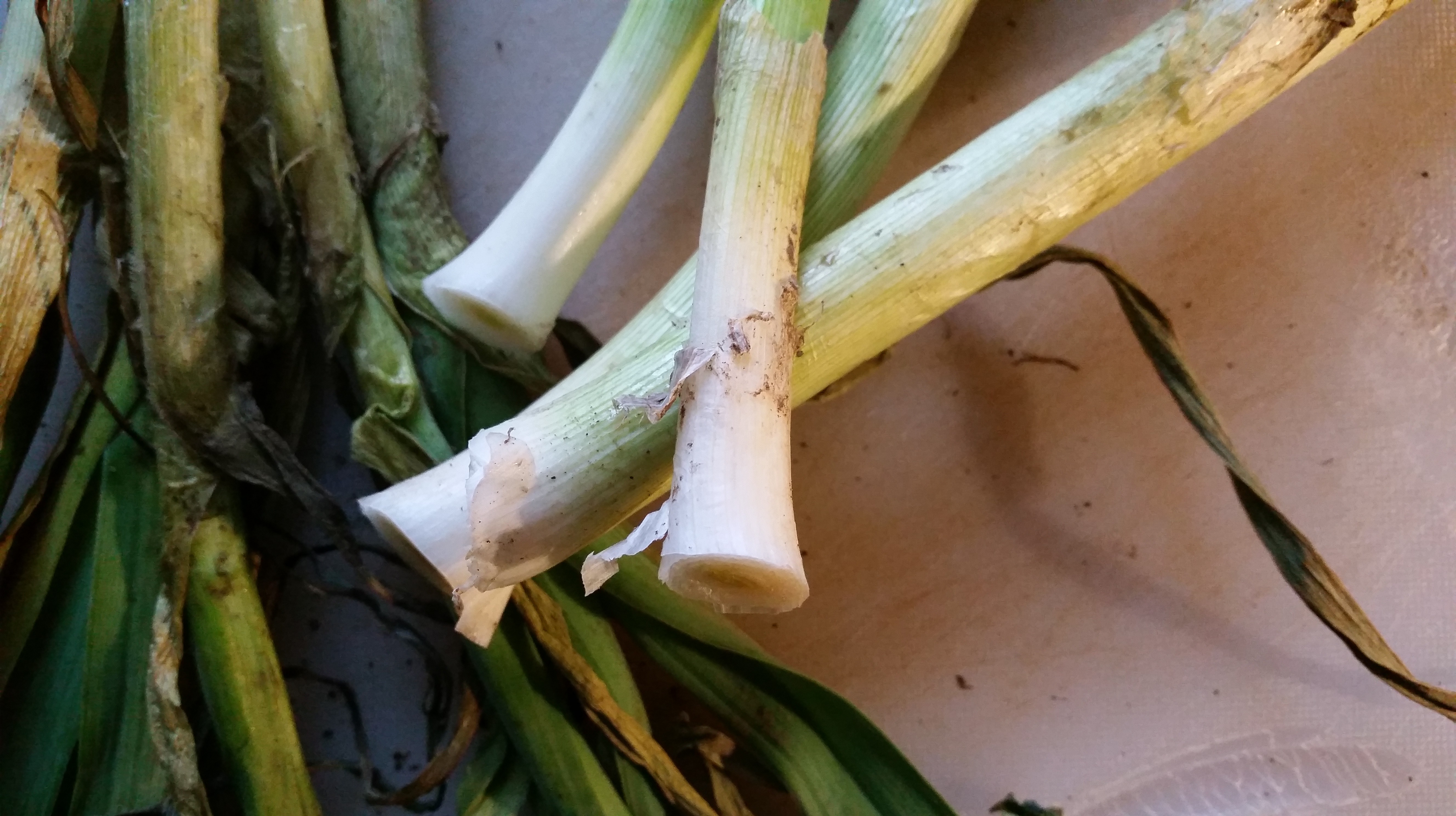
Wash leeks thoroughly as they can hold onto a lot of dirt!

Wash leeks thoroughly as they can hold onto a lot of dirt!

I don’t have much else to say about this one, except that it does everything a busy person needs: easy prep, tastes great on the day and reheats beautifully in the office microwave for days to come. Oh yeah, and it’s in season now!

I dot a bit of nonfat plain yogurt for fun!

I dot a bit of nonfat plain yogurt for fun!

Leek and Potato Soup (makes four generous bowls)

3 Tbs unsalted butter

1 lb leeks

1 pinch salt

1 lb potatoes (Yukon Gold preferred), peeled and chopped into 1/4” chunks

1 quart vegetable stock

Salt and fresh ground pepper

Melt the butter at moderate heat in a soup pot.

Meanwhile, cut off the green part of the leeks and the root end and discard. Clean the remaining white parts thoroughly. Slice the leeks roughly. Place the leeks in the butter and a generous pinch of salt and sweat the leeks for five minutes, Then lower heat to medium low and let the leeks cook for 25 minutes, until really tender.

Add the potatoes and stock and simmer until the potatoes are tender (about 15 minutes). Puree with an immersion blender or mash with a potato ricer to desired consistency. Check for salt and serve with grated pepper (and croutons if desired).

Buttery Roasted Winter Radishes and Watermelon Turnips

1 Nov

I don’t always reap what I sow, being that my garden is often a disaster and if my family depended on it for primary sustenance, the de Cubas would be no more.

Surprise! An unexpected bounty of radishes

Surprise! An unexpected bounty of radishes

But in a delightful surprise, a late summer planting of leftover radish seeds, sown in some fit of hopefulness as I cleared the beds of the unproductive detritus of a summer spent elsewhere, yielded a pound or so of very fat cherry bell and French Breakfast radishes.

Should've harvested these a week ago....

Should’ve harvested these a week ago….

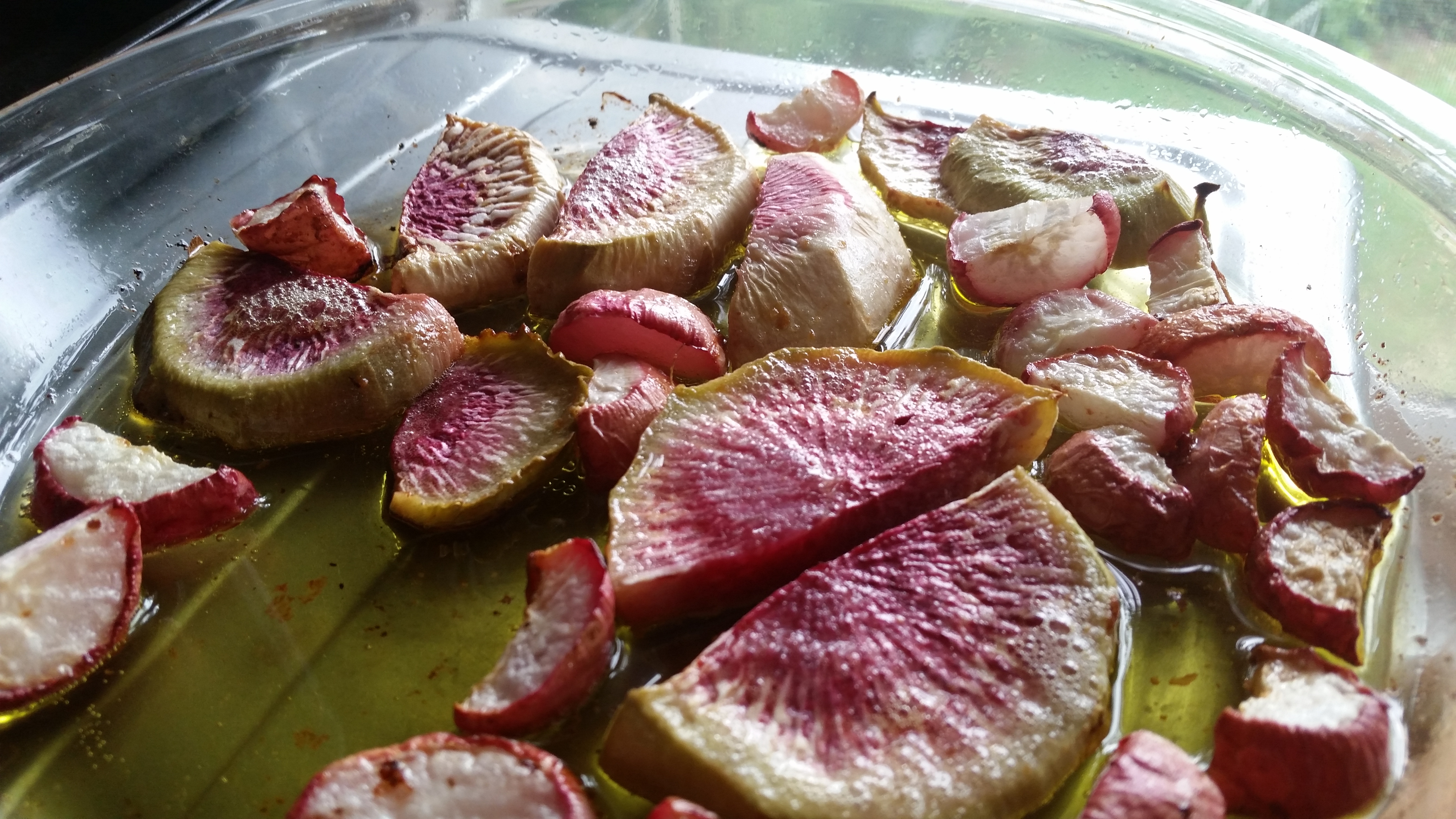
So fat, in fact, that they needed a roasting with butter to mellow the bite and soften the woodiness that comes when you don’t notice what is happening and you wait too long to harvest. It is the #gardenofneglect after all!

Another view of the surprise radish harvest

Another view of the surprise radish harvest

I added in there some watermelon turnips from our CSA (Restoration Farm), which were absolutely gorgeous, but I didn’t know what else to do with. This is the simplest recipe ever for a beautiful autumnal side dish!

A pretty plate of turnips and radishes with very little effort

A pretty plate of turnips and radishes with very little effort

Roasted Winter Radishes and Watermelon Turnips

Radishes, sliced into ¼-1/2” half moons and/or Watermelon turnips, peeled/pared and sliced into ¼”half moons

A knob of butter

2 Tbs (or more) extra virgin olive oil

Salt and freshly cracked pepper to finish

Preheat oven to 425°F

In a baking dish big enough to hold your quantity of root vegetables you have, place all the vegetables. Add a generous knob of butter (figure 1.5 Tbs for a 8×8 oven dish worth and go up a half Tbs for each inch larger). Pour 2 Tbs of olive oil over that. Stir everything around to coat and add more oil as you see fit.

Roast in the oven a half hour. Check how things are doing. The turnip will take longer, so lower heat to 375°F and roast for another half hour (you won’t burn the radishes, but the turnip will soften. I will be experimenting with a slower roast at lower temp all the way in the next few days). Sprinkle generously with finishing salt and pepper and serve.

Bok Choy, Carrot and Ginger Soup (just chop and simmer)

25 Oct

This was one of those late-season, gotta use up some veggies because tomorrow is another C.S.A. pick up, type of recipes that came together so quickly and made everyone so happy that I have to share it, even though it is embarrassingly easy and yes, I used a stock cube because I was out of chicken stock and my found veggie stocks didn’t seem the right flavor for this.

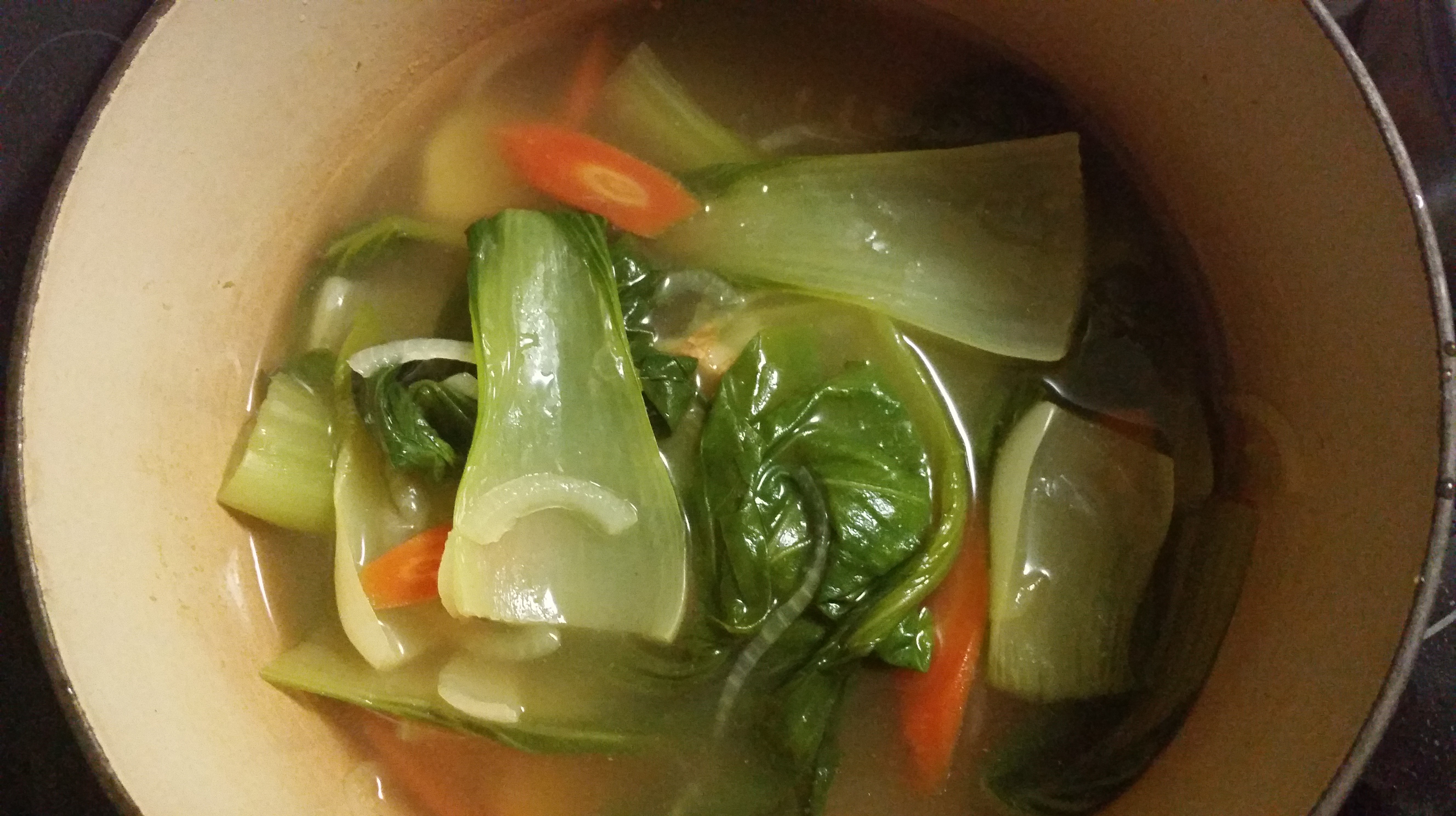
My parents went wild for this delicate soup.

My parents went wild for this delicate soup.

Bok Choy (Brassica rapa, Chinensis group) is also called chinese white cabbage and pak toi or variations thereof. There are also different varieties within this group; the one we get from Restoration Farm has kind of a bulb-like bottom (like fennel), wide stalks like chard, and green leaves like wings on either side. Look for firm yet tender stems and glossy, spot-free leaves. It is very versatile for salad, fried rice, stir fry and the like.

We loved this soup because it was so delicate and yet clearly expressed the flavors of the vegetables, the ginger, and the sesame oil. You can remove the ginger slices if you like; we didn’t. A couple of shrimp or shredded beef would not go astray here either! Done in a flash and ever so delicious!

I find this bok choy soup kind of pretty!

I find this bok choy soup kind of pretty!

Bok Choy Carrot and Ginger Soup (serves 4 as an appetizer; 2 as a very light main course)

4 Cups chicken or vegetable stock (or a stock cube and 4 Cups water)

1 knob ginger, roughly peeled and sliced in thin rounds

1-2 heads bok choy, bottom sliced off, separated and carefully washed*

½ Cup onion, sliced into half moons

2-3 carrots, peeled and sliced on the bias

¼-1/2 tsp sesame oil

½ – 1 tsp soy sauce (low sodium, if using commercial stock)

Place all ingredients in a soup pot. Add liquid to cover, if necessary. Bring just to a boil, lower heat immediately and simmer until vegetables are tender.

*My mom prefers the bok choy sliced smaller, but my dad and I like it whole. My son thinks it’s a joke that we would even suggest he try it.

Blue Ribbon Yeast Bread (no kneading required!)

18 Oct
Another blue ribbon for my little baker!

Another blue ribbon for my little baker!

Leandro has done it again! My seven-year-old won another blue ribbon at the Long Island Fair for his baking in the Junior Culinary division! What better way of celebrating than sharing it with you on the day of my 550th post and the fourth anniversary of this blog?

Sizing up the competition

Sizing up the competition

Last year it was his Oatmeal Raisin Cranberry Chocolate Chip Drop Cookies. This year it was an extension of his successful Science Fair project on yeast. We’ve been making a lot of the no-knead refrigerator bread we began making for that, so he decided that would be his submission as it is something he can do almost entirely by himself now.

The Exhibition Hall

The Exhibition Hall

This bread, slightly modified from our original to include some whole wheat flour, has terrific sponginess, nice, not-too-crunchy crust, and good yeasty flavor. (My colleagues at LINCC can attest to this, as I brought in some practice loaves)

We get better results with quick-acting yeast than regular AND we include our tips for encouraging the yeast to activate. This is the easiest bread you can imagine and you can keep the extra dough in the fridge for whenever you want warm bread.

Celebratory candy apple. Don't judge....

Celebratory candy apple. Don’t judge….

I’m so proud of him…and in a life where it’s not always clear that I am doing things right, at least I can feel that I am sending him into the world with a love of good food and an ability to feed himself. Yay us!

Fresh out of the oven

Fresh out of the oven

Leandro’s Award-Winning No-Knead Refrigerator Bread

3 Cups warm water (it should feel cozy-comfortable on the hands)

1.5 Tbs salt

1.5 Tbs quick-acting yeast

5.5 Cups unbleached white flour

1 Cup stone ground whole wheat flour

Extra virgin olive oil or other fat for greasing the loaf pan.

Container large enough to hold this much flour and water only doubled in size. You’ll want a cover for it.

Place the water in a large container and dissolve the salt into it.

Stir in the yeast until well mixed. Wait a few minutes for it to begin foaming nicely. We put it on top of a warm toaster oven to encourage yeast activity.

Add the flour, all at once. Stir with a big spoon until well mixed into a sticky dough and there are no big air pockets.

Cover loosely and allow to rise 1-2 hours in a warm place. Again, we put it on top of our toaster oven when it’s on low.

Cover (punching down if necessary) and place in fridge (for up to three weeks).

When you are ready for fresh bread, preheat oven to 450°F. Grease a loaf tin and grab a half to a third of the dough (putting the rest back in the fridge for next time). With greased hands, form a loaf (the cold dough and the fat on your hands — we use olive oil — will keep it from sticking to you), Place in loaf pan and slash across the top with a knife (for a pretty finish) and top with a bit of olive oi if desired. Bake for about 30 minutes or until crust is golden. You can give it a blast at 500°F for the last few minutes to develop the crust more.

Caldo Verde (Portuguese Sausage and Greens Soup)

26 Sep

It is late in September and I haven’t posted for you guys in weeks! Back-to-school is a challenging time, and this year my college teaching career has taken a turn for the better and busier (tenure track, presentations, grant-writing, event-planning AND a new edition of the textbook), so I have been all-in at the college and all out of commission in the food-writing biz.

But that doesn’t mean I have been ordering take-away dinners. I just haven’t been narrating our every meal! (And I haven’t been doing much new stuff either, but sticking to my tried-and-true reliable recipes.)

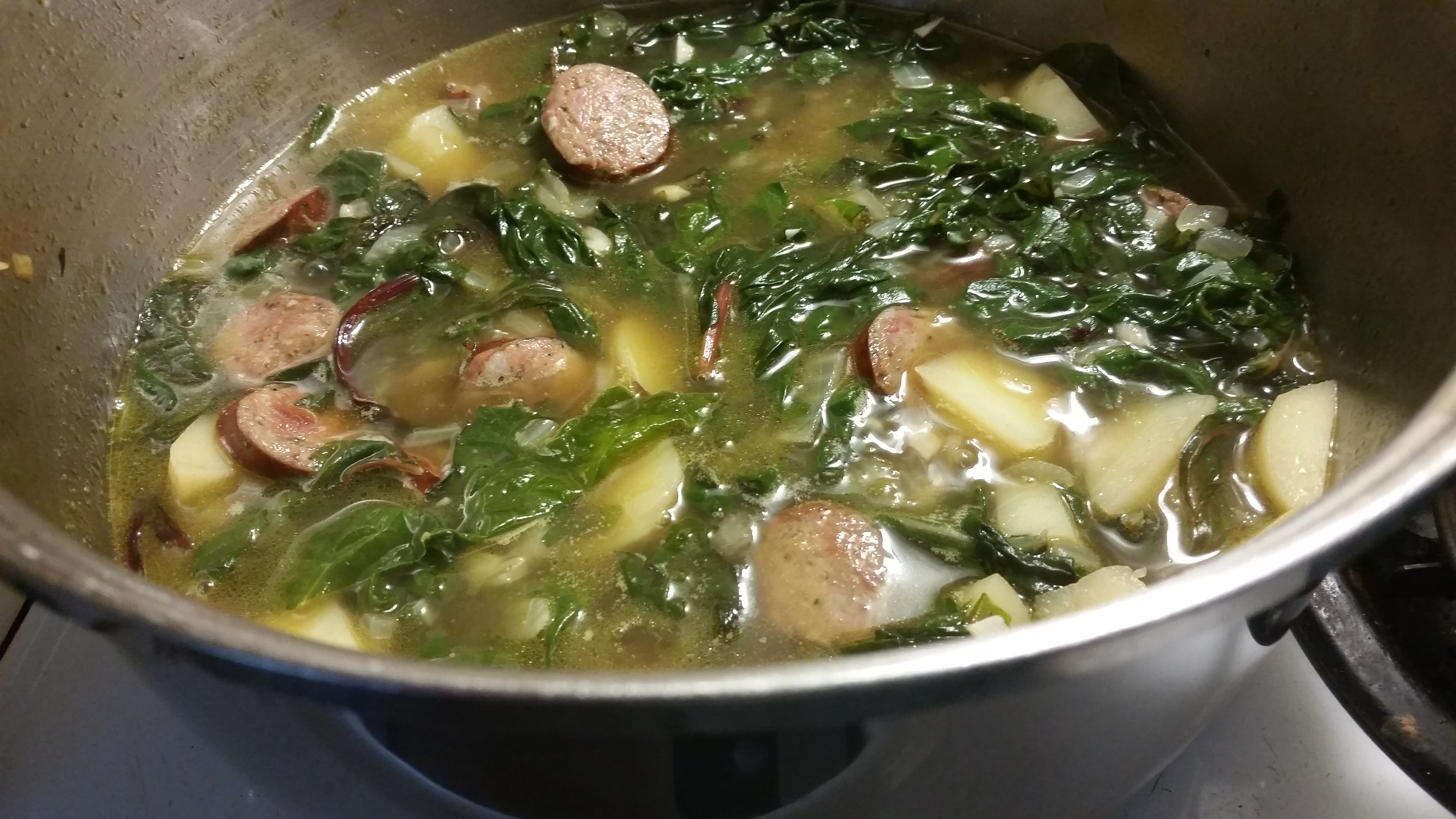
Andouille sausage is not, perhaps the most traditional choice, but it works!

Andouille sausage is not, perhaps the most traditional choice, but it works!

However, a good price on some DArtagnan andouille sausage at Fairway Market and armfuls of late summer greens from Restoration Farm CSA and a kicking homemade beef stock in the freezer assembled themselves in my head into a delicious soup for the cool early fall air. When I say assembled themselves, I mean it: this is an easy-peasy soup that doesn’t take much effort.

I will post more in the coming days, I hope; I have a few Edible Long Island articles to catch you up on as well!

A delicious soup for a cool day when you want a soup that warms but doesn't overstuff you

A delicious soup for a cool day when you want a soup that warms but doesn’t overstuff you

Caldo verde (Portuguese green soup with sausage)

2 generous tablespoons extra virgin olive oil

6 oz andouille (or other spicy, robust sausage), sliced in ¼ rounds

1 Cup onion, diced fine

2 Tbs garlic, minced

6 Cups sturdy, leafy greens (kale, collards, escarole, chard, beet greens), cleaned and torn into largish pieces

2 Cups potatoes, cubed

6-8 cups cooking liquid; at least four Cups being a good, flavorsome, low-salt stock

Salt and pepper to taste

Heat the oil in your soup pot until rippling. Add sausage and lower heat to medium. Cook sausage until browned and remove to a plate, setting aside for later.

To the seasoned oil, add the onions and garlic and sauté at medium-low until translucent and tender (the longer the better). Add your leafy greens and wilt briefly. Then add potatoes and cooking liquid. Bring to a boil, then simmer until greens and potato are tender (15-20 minutes). (some people mash or put the broth into the food processor at this point; I don’t, but might start to convince the little guy it is pesto soup?) Return sausage to the pot, warm for five minutes and serve in bowls with crusty bread.


Linguine with Spicy Scallop Marinara

28 Aug
Whew! What a summer! Four weeks in Puerto Rico, another week in Chincoteague, VA, plus wall-to-wall activities, nonstop writing for the Edible publications…it’s been great, but I am afraid I have not posted here as often as I would have liked.
 
More garlic, cause that's how we roll.

More garlic, cause that’s how we roll.

If you think I have neglected this, you should see the #GardenofNeglect in my raised beds. Once again, the champion of zucchini failure failed to get even one lousy zucchini, bringing my three-year grand total to ONE. Ah well, fall plantings are in and I see a few radish greens popping up, so maybe we’ll get something going there now that we are home.

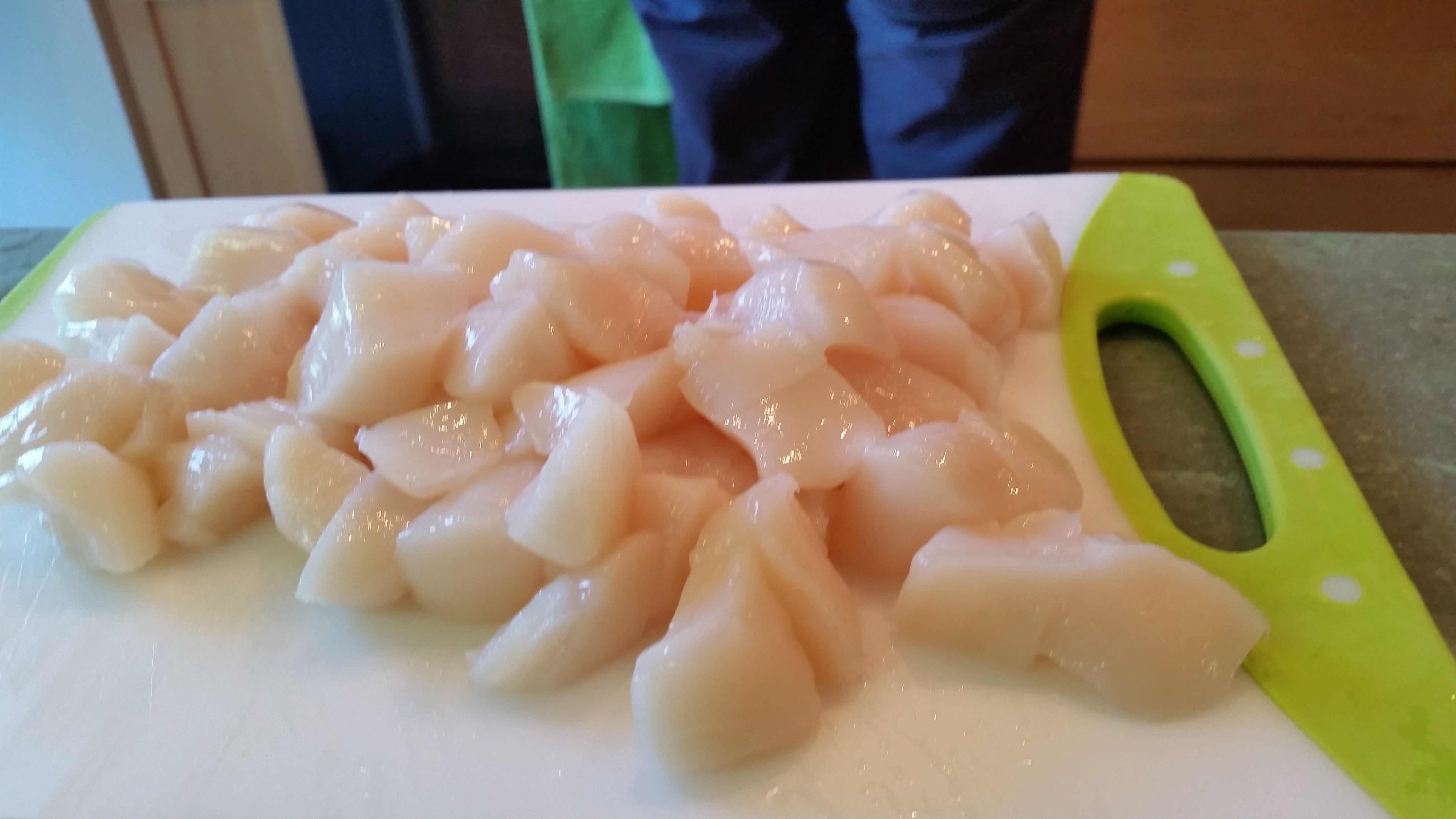
Sweet, tender Chincoteague scallops are a treat

Sweet, tender Chincoteague scallops are a treat

 
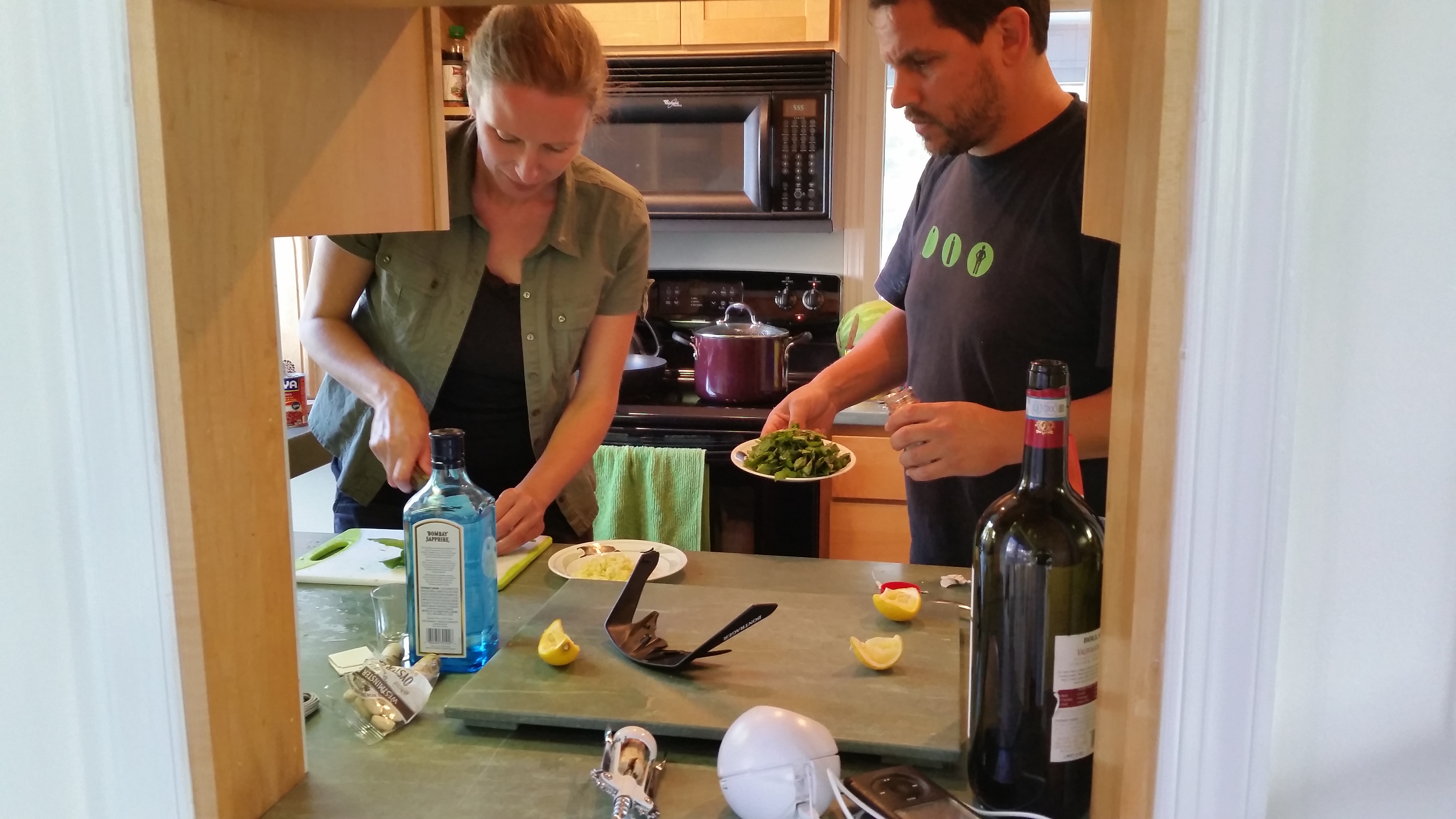
Anyhoo, this recipe is something my brother and sister-in-law put together while we were in Chincoteague to take advantage of the superb sea scallops available there. Apparently this is a new go-to for them in their home in Canada, warming without being heavy.
 
Hard at work in the kitchen

Hard at work in the kitchen

They based it on a Food Network recipe that uses spaghetti, parmesan rind and much less garlic than my brother bungs in. Why you would want to use less garlic is beyond my comprehension, but to each his/her own! You can use less than the amount called for in my brother’s version, but for my money, he has the right idea using a lot.

 
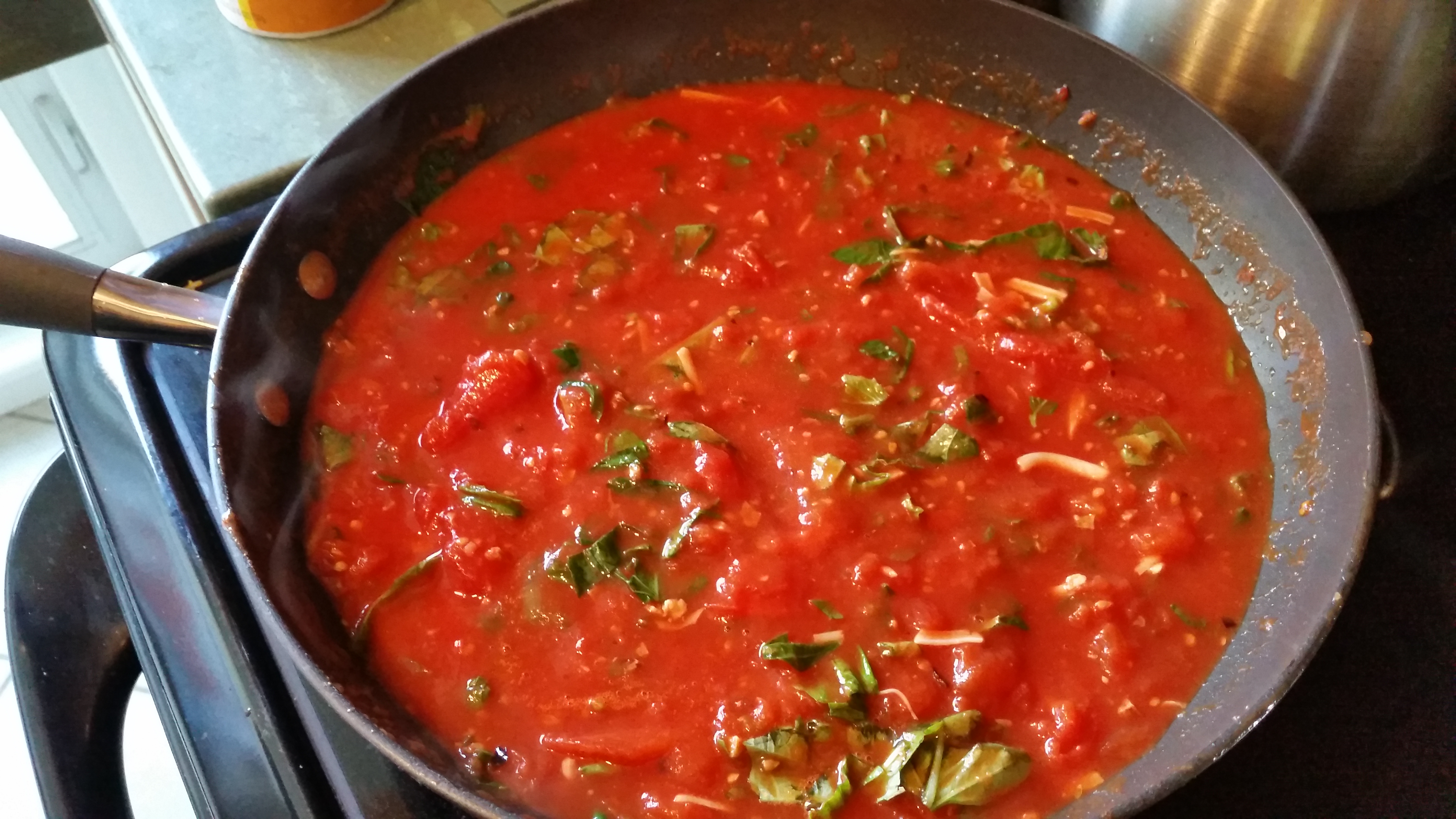
Look at that color...

Look at that color…

It was truly delicious, with bright clear flavors and not difficult at all to put together. I think it will become a go-to here in New York too!

 
Let's eat!

Let’s eat!

Linguine with Spicy Scallop Marinara

(serves four to six)

Kosher/coarse salt
1lb linguine
1 tablespoon extra-virgin olive oil, plus more for drizzling
  6cloves garlic, minced
1/4 to 1/2 teaspoon red pepper flakes, plus more to taste
1 28 -ounce can whole San Marzano tomatoes, crushed by hand
1 cup loosely packed fresh basil, sliced, plus more for topping

grated Parmesan to taste
3/4 pound bay scallops or sea scallops cut into 1″ chunks

Cook pasta according to package direction. Before draining, reserve 1/4 Cup cooking liquid.

Meanwhile, heat the olive oil in a saucepan over medium heat. Add the garlic and red pepper flakes and cook, stirring, until the garlic softens, about 1 minute. Add the tomatoes, 1/2 cup water and half of the basil. Bring the sauce to a boil, then stir and reduce the heat to medium low; simmer 15 minutes. Season with salt.

Increase the heat under the sauce to medium high, add the scallops and cook, stirring occasionally, until opaque, about 5 minutes. Add the remaining basil, stir in the parmesan and season with salt and more red pepper flakes.

Drain the pasta and add to the skillet with the sauce; toss. If you need more liquid, use the reserved cooking liquid. Divide the pasta among bowls, drizzle with olive oil and top with more basil.

A view from the kitchen

A view from the kitchen

New Favorite Nosh: Tomato and Cucumber Sandwich!

19 Aug

This is barely a recipe, but it’s what I have been eating for breakfast and lunch (and sometimes in between with a cup of tea).


I like it with rye toast (shown here), but it reaches its apex with white bread....

I like it with rye toast (shown here), but it reaches its apex with white bread….

Toast and butter two slices of bread. Layer thinly-sliced cucumber (peeling is optional) and tomato – preferably fresh from the garden – on the bottom slice. Sprinkle with salt and top with the second slice. Cut in half and eat!


Garbanzo (Chick Pea) Salad with Tahini, Black Olives and Sun-Dried Tomatoes

13 Aug

I love garbanzos (chick peas, ceci) in all different ways, but especially as a salad or salad topper. They add meatiness and texture to everything and taste great with loads of garlic and onions.

Also, very versatile...

Also, very versatile…

Here is a quick and easy salad that uses up the bits and bobs you have in your fridge. When I make this kind of salad, I feel as though I am just giving it everything I’ve got; you’ll notice that the quantities of each ingredient can vary to your taste and availability. We’ll be having this one tonight with cold leftover chicken, perhaps some marinated artichoke hearts, an olive assortment, some pistachios and clementines. Delicious light dinner!

A worthy accompaniment to summer meals

A worthy accompaniment to summer meals

Garbanzo Salad with Tahini, Sun-Dried Tomatoes and Olives

2-3 Tbs extra-virgin olive oil

½ – 1 tsp apple cider vinegar

Juice of half a lemon

1-1 Tbs tahini

Pinch salt

1 Tbs garlic, minced

2 Cup garbanzos (soaked or from a can)

¼ Cup onion, chopped fine        

¼ Cup green pepper, chopped fine

2 Tbs sun-dried tomatoes, diced

1-2 Tbs pitted black olives, sliced

1 Tbs fresh parsley, chopped

In a serving bowl, whisk the olive oil, vinegar, and lemon juice, until smooth. Stir in tahini until smooth, then a bit of salt. Add remaining ingredients and mix well, adding additional salt if desired. Serve over salad greens or rice.

Georgia Kalamidas’ Purslane Salad (Another weed made useful!)

12 Aug

We were a bit bemused to find this thick-leaved rubbery-stemmed plant called purslane (Portulaca oleracea) in our pick-up and completely unsure of how to use it. It seemed to be the exception to the CSA rule of thumb: “When in doubt, saute in garlic and oil.” What to do?

Purslane is a succulent. those fat leaves hold water during drought.

Purslane is a succulent. those fat leaves hold water during drought.

Fortunately, our Restoration Farm grower Caroline Fanning provided a recipe from someone I think is another another member, Georgia Kalamidas (duly credited here) and the Internet provided more info on what this thing is. Apparently, some folks think it is a beautiful edible ornamental. Others think it is a weedy, resilient pain the gardener’s ass.

University of Illinois Extenson educator, Sandra Mason in a very funny and informative piece called “Purslane: Weed it or Eat it?”  discusses the relative merits of purslane in the garden. For example: “Purslane is an annual reproducing from seeds and from stem pieces. Seeds of purslane have been known to stay viable for 40 years in the soil. You may find that fact either depressing or exciting.”

Use it or lose it. One day after pick-up this needed using

Use it or lose it. One day after pick-up this needed using

The edible nature of this useful weed is another story. In young plants you can use the stem. My pick-up partners, Lori and John, and I tasted the stems and were not impressed. So we removed the leaves (it takes a while, so factor in time for that), rinsed thoroughly (purslane generally grows close to the ground) and followed Georgia’s recipe. The purslane is a bit like watercress without the nuttiness, and a bit like parsley but milder. In fact, you could substitute either in this salad, which was absolutely refreshing and delicious, with a lot of brightness and crunch. And by the way, you can apparently saute it in garlic (the rule stands!), and also in soups, but don’t cook it too long or it will become mucilaginous (slimy, like okra). Also, next time I might substitute oregano for the mint and add feta. Click for basic recipe! Continue reading