Archive | Uncategorized RSS feed for this section

French Chicken in a Pot

20 Dec

In case you were wondering (TW, Donna, Lesly, Trish, and Steve in particular!) what I did with the last two pastured birds from the Restoration Farm Chicken Project…well let me catch you up!

Those new to the blog should know that we participated in a pilot pastured chicken share at our C.S.A. initiated by Trisha Hardgrove. The birds, five in all, were raised out on the farm, grazing and eating organic feed and processed right on-site. They were extraordinarily tasty and the texture was beautiful. So far I’ve done a traditional Asopao de Pollo (Soupy Chicken and Rice), a Rosemary-Lemon Roasted Chicken, and a Tandoori-Style Roast Chicken . My dad did the fourth in a lovely and warming chicken noodle soup, but I don’t have the recipe for that.

For the fifth and final bird of the season I went with another Cook’s Illustrated recipe, with, once again, only the very slightest modifications (a bit more rosemary, for example). The skin wasn’t crispy, but O.M.G. the tender savory chicken and the PAN JUICES. Wow. The secret is the Dutch Oven and not roasting your side vegetables in the same container, as they release a lot of liquid and dilute the chicken juices.

The instructions may look a bit long, but it is really easy – prep and forget. Effortless excellence!

I did oven-fried sweet potatoes separately for this one.

French Chicken in a Pot

You need a 6-quart Dutch oven with tight-fitting lid for this recipe

One 4.5-5 lb chicken, giblets removed

Salt and pepper

1 Tbs olive oil

1 small onion, chopped roughly

1 small rib celery, chopped roughly

6 garlic cloves, peeled and smashed

1 bay leaf

2 sprigs fresh rosemary (if desired)

½ – 2 tsp fresh lemon juice

  1. Place oven rack on lowest position and hear oven to 250°. Pat chicken dry with paper towels, season generously with salt and as much pepper as you see fit. Tuck wings behind back.
  2. On the stovetop, heat oil in Dutch oven over medium heat until just smoking. Add chicken, breast side down; scatter onion, celery, garlic, bay leaf, and (optional) rosemary sprigs around chicken. Cook until breast is lightly browned, about 5 minutes. Using wooden spoon inserted into cavity of bird, flip chicken breast side up and cook another 6-8 minutes, until you get nice browning on chicken and vegetables.
  3. Off heat, cover top of pot tightly with aluminum foil and cover with lid. Transfer pot to oven and cook chicken until breast registers 160° and thighs register 175°.
  4. Transfer chicken to carving board, cover loosely with foil and rest for 20 minutes. Strain chicken juices from pot through a strainer and discard the solids. Let juices settle for 5 minutes , then set over medium heat in a saucepan. Carve chicken, adding additional juices to saucepan. Season with lemon juice and salt and pepper to taste. Serve chicken, with the sauce passed around separately.


Pear, Berry and Goat Cheese Hors d’ouevres ¡Que Chévrere!

16 Dec

Once again, I underestimated how much time I had to make food and how much time each item would take. Regular readers know that I am trying not to fuss when guests come over, but I got a bit ambitious for a Lucas and Amanda playdate and ended up slicing and cooking more than talking for a good part of the early evening.

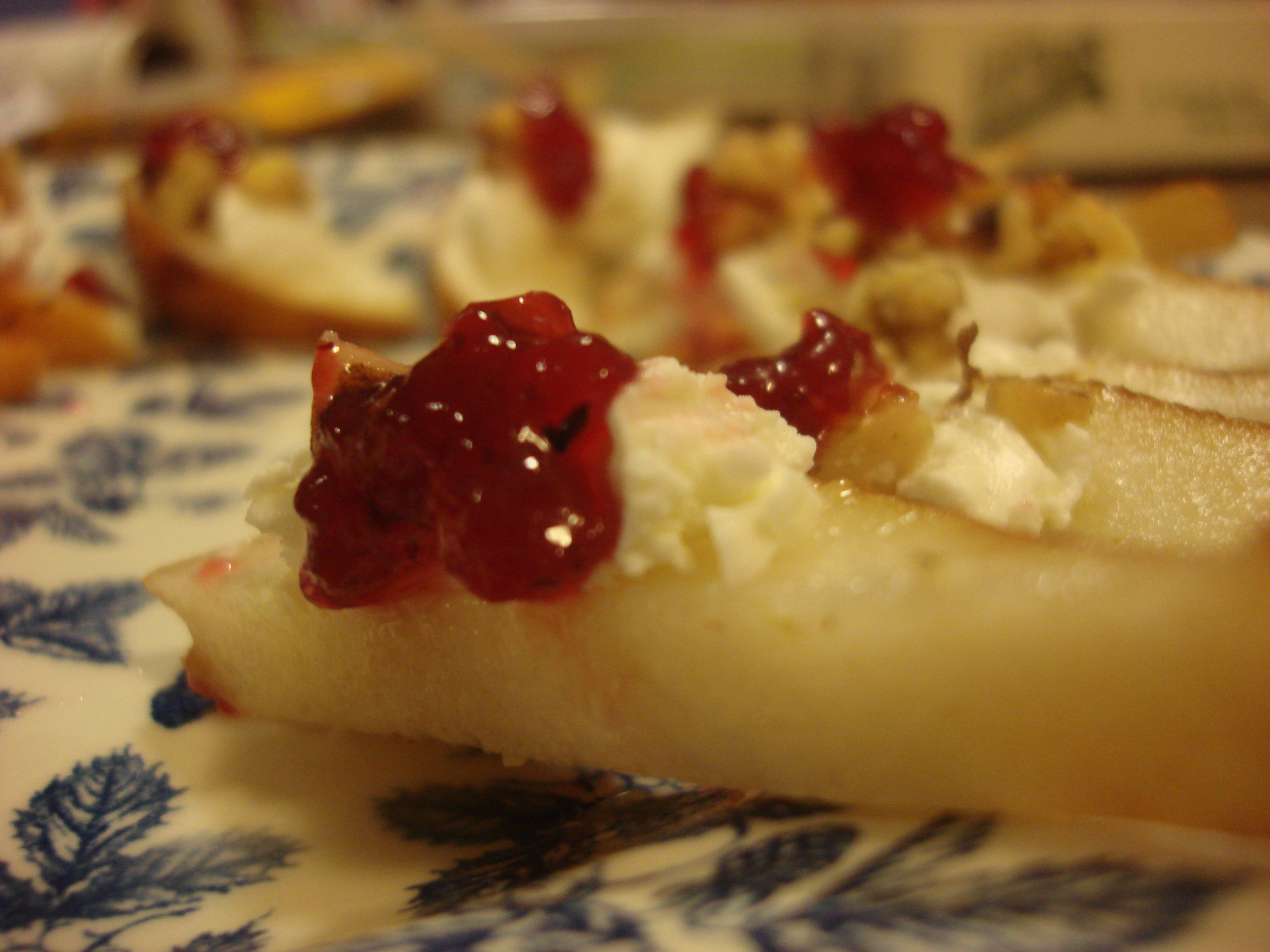
However, my trip into the weeds of food prep was well worth it, if only for this one new, festive appetizer that looks so pretty and explodes with flavor.

Inspired by a holiday recipe I saw in a magazine last time I went to get my hair done, I picked up some Bosch pears. The original recipe called for Camembert, but I couldn’t find it during my very brave (or ill-advised or just plain crazy?) trip to the nearest Costco Warehouse in the middle of the holiday shopping season with its completely lawless parking lot with a just a half an hour before I had to pick up both little lunatics from the daycare. I cut my losses, grabbed some goat cheese, extricated myself from Costco without incident, and hit the refresh button on my recipe plans.

I had just got the litle guys into a groove at home (which involved unforeseen complications, like my son’s grumpy mood, and taking out the old-fashioned spiral corer and peeler for them to prepare their own apples and other such mommy activities) and Amanda was already at the door! But no harm done – the fizzy stuff was cold and all I had to do was some quick assembly for the starters.

Later I bunged Lucas’ favorite Flex-Mex Shredded Chicken chicken in to a pot and all was well (although admittedly the kids were moaning for food by the time I had it all together – why, why, why do kids decide to get hungry EARLY just when you are overwhelmed? And is there any sound more grating — and distracting — than the whine of your little emperor child when you are trying to concentrate on getting him what he wants anyway? Sheesh!)

So, for the holidays, try this with a dry sparkling wine – we had Frexienet, but I might go with a dry prosecco the next time. Amanda, my colleague, Maryanne, and I loved this up and I think you will too!

Pear, Berry and Goat Cheese Hors d’ouevres (makes a light appetizer for two)

1 Bosch Bear, core removed and sliced into thin wedges (I used a push-down apple core-and-slicer and then sliced each segment in half)

1 tsp lemon juice

2 Tbs creamy goat cheese (chevre)

2 Tbs walnuts, chopped fairly fine

1 Tbs lingonberry jam (raspberry or red currant would also work)

Arrange pear wedges on a plate. Sprinkle with lemon juice to prevent browning. Add a dollop of goat cheese. Top with walnuts and a bit of jam. Serve immediately.

Tostones: Puerto Rican French Fries – Made of Plantains!

8 Dec
If you have ever eyed those oversized, overthick, green banana-looking things in the supermarket and wondered what people do with them, this is your great revelatory moment.

Pre-soaking in salted, garlicky water

Those things are plantains – Musa paradisiaca – a kind of banana we in the Caribbean use to make all manner of delicious, stodgy things, preferably plunged into hot fat and heavily salted. Plantains originated in SouthEast Asia or the Near East or thereabouts and came over with colonialism. They flourish in the tropics and are now integral to the Caribbean culinary canon.

Fry and smash

Tostones – called patacones in other parts of Latin America – are disks that – much like French fries – are sliced and fried twice -once to cook through and the second time to crisp. As the holidays approach and I feel more and more festive, I am saying “Calories be damned, I need some of those!” So I’ve been making tostones for dinner. Yes, the whole meal. And we are all loving it.

Assembly line: note beautiful Pipo Grajales-made tostonera in background

My son dips them in ketchup, my favorite Dominican restaurant serves them with a garlic mojo sauce, and Puerto Ricans like them dipped in mayo-ketchup, a quick stir of mayonnaise and ketchup (that Kraft actually markets on the island!). These days I just sprinkle salt on them; some folk like garlic salt or powdered garlic. Years ago my friend, Chef Patricia Wilson pioneered serving them topped with sour cream and caviar at noted Old San Juan restaurant Amadeus…with a flute of dry sparkling they dress up real nice. You can dip them in hot soup too…mmmmm.

So give tostones a try; the first soak in water is critical; the second one less so, but it doesn’t really add much time to the procedure and it does add flavor and texture, so why not?

 Tostones (Fried green plantains, serves four as a meal, 6-8 as a side)

(Note: you will need two boards or two plates to smush the disks between rounds in the frying pan)

5 green plantains*

3 cloves garlic, peeled and smashed

4 Cups water

2 tsp salt

¾ – 1 Cup vegetable oil (for frying, enough oil to be about ½ inch deep in your chosen frying pot or pan)

Preparing the plantains:  Slice both tips off. With a knife, make lengthwise slits through the peel on two sides. Try not to pierce the flesh too much. Peel the thick skin off.

Stir garlic, water and salt in a bowl. Slice the plantains into ½ inch chunks, on the bias, and place slices in bowl of salted water. Soak for 15 minutes to one hour. Drain on paper towel.

Heat the oil in a heavy pot or pan.  When the oil is shimmering, add as many plantain slices as will fit comfortably. Fry until golden (really golden – not just beige) turning with tongs.

This is where you begin to make an assembly line. Be ready with a couple of plates covered in paper towels for absorbing oil.

Remove and lay the first set on paper towels and place the next round in the hot oil. While the second set is frying, take the first set (the one you’ve already fried) and squash fairly flat in a tostonera, if you’ve got, or between two plates. Dip in the salted water and lay back on the paper towels. You may have another raw set to go (it depends on the size of your fry pot).  Follow the same pattern until all plantain disks are pre-fried until golden, squashed flat, and dipped. Then start returning plantain disks for the final fry to crisp them up. Remove when beginning to brown and lay on clean paper towels until cool enough to eat.

*Look for firm, green, thick skins. As they yellow, they become sweeter and have other uses…

Classic Spanish-Caribbean Black Beans (Frijoles Negros) and Perfect White Rice

4 Dec

I have a four-year-old boy, so you know that toilet humor reigns supreme around here. I don’t particularly like all the burp and fart and poop talk, but I am a pragmatic woman; I try to make my reality work for me and try not to dwell on the way things “should” be.

So, what passes for classic poetry in my house starts out, “Beans, beans, good for your heart…” and you probably know the rest. I have no problem getting Leandro to eat beans several times a week; what preschooler could resist the lure of stinking out family and friends with such jackhammer potency? It goes much the same for asparagus; I reeled him in with the promise of sulphurous-smelling pee and now it’s one of his favorite (of very few) vegetables.

This is perhaps not the most appetizing of ways to introduce a recipe, but I’ll take my chances that you are interested enough in making fast, easy and healthy black beans that taste just as good as whatever you get in your local Cuban joint to overlook the other factors. Or, if you are a boy of any age, perhaps it is just the intro you need to start incorporating more beans into your diet!

(Note: the more often you eat beans, the better your body processes them, so some of the gassy part dissipates over time. And the low-fat, fiber, protein benefits are incredible. They are also cheap, especially if you soak your own*).

Classic Latin Black Beans (Frijoles Negros)

1 Tbs olive oil

1 medium onion, chopped

½ red or green bell or cubanelle – Italian long sweet – pepper (about ¼ Cup), diced

3 cloves garlic, minced

28 oz can black beans, rinsed and drained (4 Cups if using dried*)

½ Cup water (you can add more as needed)

1-2 stock cubes (vegetarian vegetable is fine; I use Knorr chicken)

1 Tbs dry oregano (or 1.5 fresh)

1 tbs cider vinegar (optional)

Heat olive oil in a heavy soup pot at medium high until fragrant. Add onion and peppers and stir to coat. Lower heat and cook until softened, about five minutes. Add garlic, stir to coat and cook another minute. Add remaining ingredients. Bring to a boil, then cover and lower heat to simmer, about 15 minutes. Serve with white rice (recipe below).

*Soaking dried beans: Rinse a pound of beans (from a store that seems to move a lot of dried beans – one of the problems is that if the beans are old, they will never soften up nicely), soak them in two quarts water overnight. Change the water in the morning and in the evening rinse and change water. Simmer them for two hours and holy legumes, Batman: 1.5 quarts of beans to play with.And talk about cheap: a pound of dried beans costs about the same as a 15.5 oz can of them and you choose how much sodium you want with it.


Perfect White Rice (you can halve this recipe if you are not big into carbs)

1 Tbs olive oil

2 Cups long-grain white rice (Sello Rojo, Goya or other Latin brand preferred)

4 Cups water

½ tsp salt

Place olive oil in a medium pot (with a tight lid). Begin heating to high while adding the rice. Stir to coat, Add water and salt. Stir once, then bring to a boil. Lower heat to medium and allow water to evaporate until it goes below the surface of the rice and there are a couple of holes in the surface. Turn rice over once with a big spoon. Cover and cook on low another ten minutes. Fluff with a fork and serve.

Butternut Squash Bisque and Bonus! Pepitas (roasted winter squash seeds)

27 Nov

In theory, starting a meal with soup will tend to make you eat less during the rest of the meal.

Well, maybe it’s true for some people, some of the time, but not so at Thanksgiving, where no matter how much I snack or soup ahead of the Big Feast I still eat ridiculous amounts of food during the main course.

Incredible Restoration Farm squash - LOOK at that color

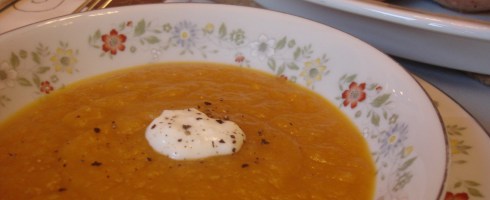
However, hope springs eternal and therefore in this house we start the Thanksgiving Eat-a-thon with this creamy winter squash bisque. It is not just for Thanksgiving though; this bisque is lovely for any fall meal, and you can use any of the hard-rind winter squash available in autumn and throughout the cold season.

Bonus recipe? What I call pepitas – roasted winter squash seeds that you can use to garnish your soup, or to snack on while you are making the meal or to give to your kid who is feeling a bit neglected by all this focus on food prep.


Pepitas!

Butternut Squash Bisque

(makes four to six cups)

2 Tbs unsalted butter

3 cloves garlic, chopped fine

2 ribs celery, diced (about 1 Cup)

1 onion diced (about 1 Cup)

2 leeks, carefully cleaned and diced (white part only)

2 lbs squash flesh (about 5 Cups)

2 quarts chicken or vegetable broth

2 Tbs dry white wine

1 Tbs grated ginger

Salt, to taste

½ tsp ground nutmeg (optional)

1/2 cup plain yogurt (or sour cream or crème fraiche)

Heat the butter in a soup pot over medium heat. When any bubbling subsides, add the garlic, celery, onion, and leek. Cook, stirring occasionally, until the onion is translucent (8-10 minutes). Add the squash and broth. Bring to a boil and immediately reduce heat to a simmer. Cook until vegetables are tender, about 30 minutes.

Meanwhile, heat wine to a simmer in a small saucepan. Immediately remove from heat, add ginger and cover. Steep 10 minutes, then strain the wine and discard the ginger.

Strain the solids from the soup, reserving liquid. Using a food processor or immersion blender, puree the solids, adding enough of the reserved liquid to get a good consistency.

Add the wine to soup and season with salt and optional nutmeg. Grate additional ginger into the soup, if desired, using a fine grater. Serve, garnishing each bowl with a dollop of yogurt. You may also garnish with 

Roasted Winter Squash Seeds (pepitas)

Handful winter squash seeds (however many you get from prepping the squash), rinsed, cleaned and dried

Enough extra virgin olive oil to lightly coat your amount of seeds (start with about a tsp poured into your palm)

Salt to taste

Heat oven to 275°F. Line a baking pan with foil or parchment paper. Rub seeds with olive oil, lay in a single layer on baking pan, sprinkle with salt and bake for 15 minutes until seeds start to pop. Cool in a bowl and serve.


Festive Turkey Salad (With sweetness AND crunch!)

25 Nov

Happy Thanksgiving all! Regular readers will recognize this post from LAST Thanksgiving!!! See you soon; I am off to make broth…

My favorite quick dress-up for food that takes me from workaday-dull to bright and shiny: dried cranberries and walnuts.

My take-to-work breakfast? Plain nonfat yogurt, swirled up with some honey, a handful of cranberries and another handful of walnuts (bought in big bags at Costco – they last and last). Crunchy, creamy and sweet – oh yeah.

At home, I add them to spike up instant oatmeal. I also substitute half the raisins in oatmeal raisin cookies with cranberries for a brighter flavor and add walnuts for crunch and depth.

Boring salad? Add handfuls of cranberries and walnuts and make it fancy-schmancy (especially good with orange/clementine segments, red onion and feta – separately or in combination).

Today I incorporated them into my leftover turkey salad. Zippy!

Leftover Turkey Salad

leftover turkey, removed from bone, gristly bits removed, and chopped into small squares (2-3 cups)

handful dried cranberries

handful chopped walnuts

one celery stalk, chopped fine (mostly because I don’t really like celery)

half a red onion, finely chopped

4 -5 Tbs mayo and nonfat plain yogurt in whatever ratio you prefer

1 Tbs brown or yellow mustard

Mix all together in a bowl and serve in sandwiches or over salad.

Notes: Cranberries (Vaccinium macrocarpon), blueberries and Concord grapes, are the only commercially-grown native North American fruits! They are loaded with vitamin C and dietary fiber and manganese and other good things and may very well help prevent some urinary tract infections in women, but the jury is still out on that.

Party Snacks: Endives, Smoked Salmon, and Capers (Endivias con Salmón)

22 Nov

My parents usher in every holiday season with a Tapas & Tertulia evening for some of their closest, most worldly-wise, food-loving friends from a number of Spanish-speaking countries. Tapas are the little dishes that the Spanish nosh on while drinking small glasses of beer or wine. A tertulia is a convivial gathering – of intellect or music or literature or other sociable human tricks.This evening is one I always look forward to; the conversation is wide-ranging and stimulating, the laughter hearty and the appreciation of food is foremost.

I helped my folks by making some of the mainstays of the tapas/buffet table – tortilla española, tortilla Torcal (with chorizo and ham), yuca en escabeche.

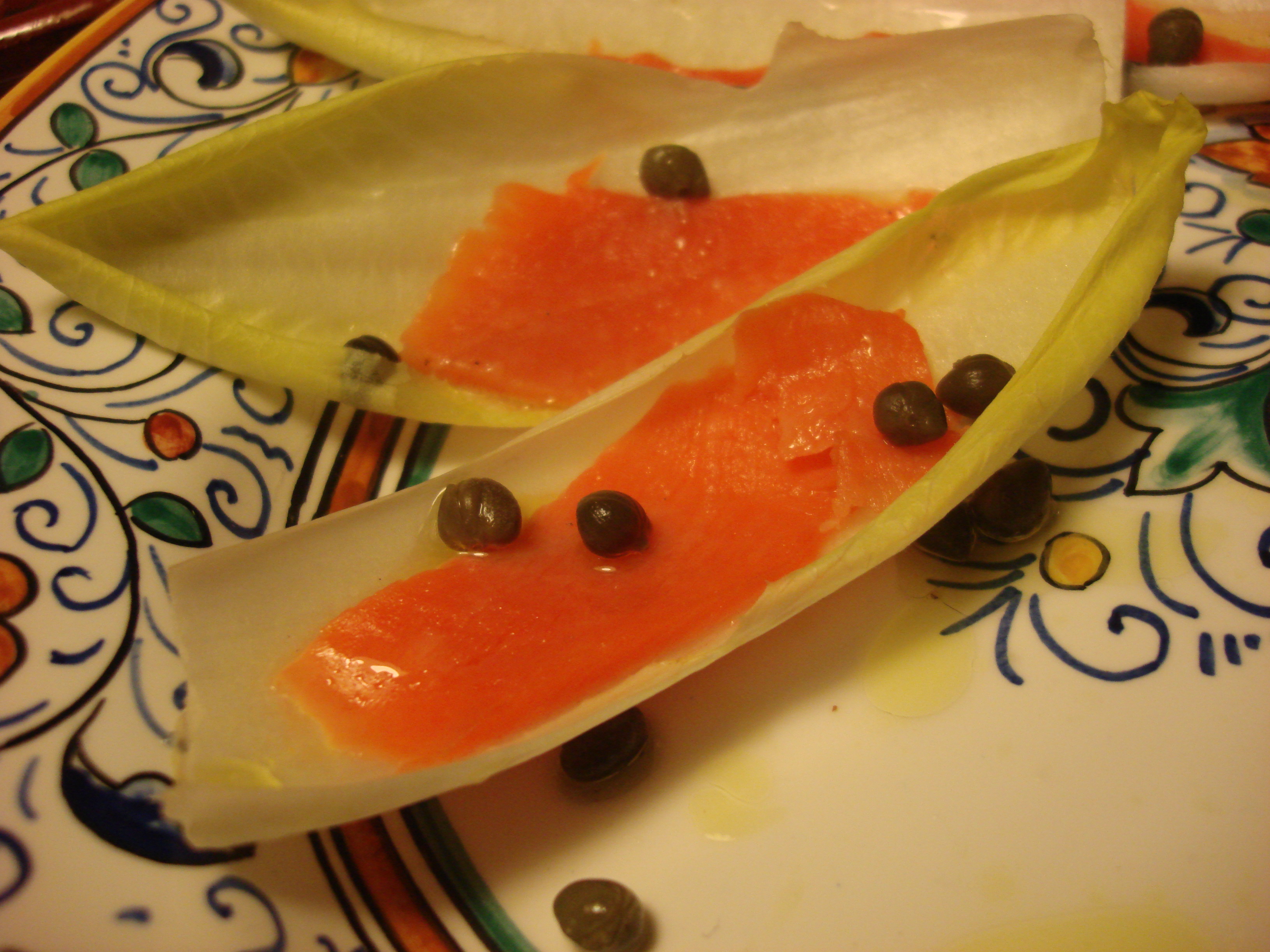
While searching for something new for the cold course, I found this in Tapas: The Little Dishes of Spain, by Penelope Casas, a hero of Spanish cuisine in America and a longtime inspiration around here. The endive makes a handy tray for the salmon, while salmon is made mild by the lemon dressing. One of my adaptations was to add capers, a natural for this combination, both as flavor and visual punctuation. Very pretty, very fresh, very handy, very, very fast and easy!

Please look at the photo and know that endive can mean any of several members of the Compositae family of chicories: escarole, chicory itself and radicchio, for example. Belgian endive (Chicorium intybus) is the one you want here. It looks like a tightly closed tulip; you cut off the bottom and take off the scoop-shaped petals, one by one.

Smoked Salmon and Endive Scoops (Endívias con salmón)

4 oz smoked salmon, sliced into strips

12 Belgian endive leaves, clean and unblemished

3 Tbs extra virgin olive oil

1.5-2 Tbs fresh lemon juice

Salt

Freshly ground pepper (white, if you’ve got)

Approximately 50 small capers, drained

Lay a piece of salmon on each of the endive leaves. In a small bowl, whisk the oil, lemon juice, salt and pepper and pour over the filled endive leaves. Scatter capers over each scoop (3-4 per scoop). Serve immediately or keep chilled (for no more than an hour as they can start to dry out).

Walnut Toffee Triangles (freezeable, portable holiday deliciousness)

20 Nov

When Marianne called me the other day to start some holiday baking I thought “What!?! Already!?! It’s too early!” But Marianne is a woman who knows what she’s about in the kitchen; she will have a full house on Thanksgiving and has no time to mess around. 

Even though it seemed like madness, I knew there had to be a method behind it.

And of course there was. Like I said, Marianne doesn’t mess about.

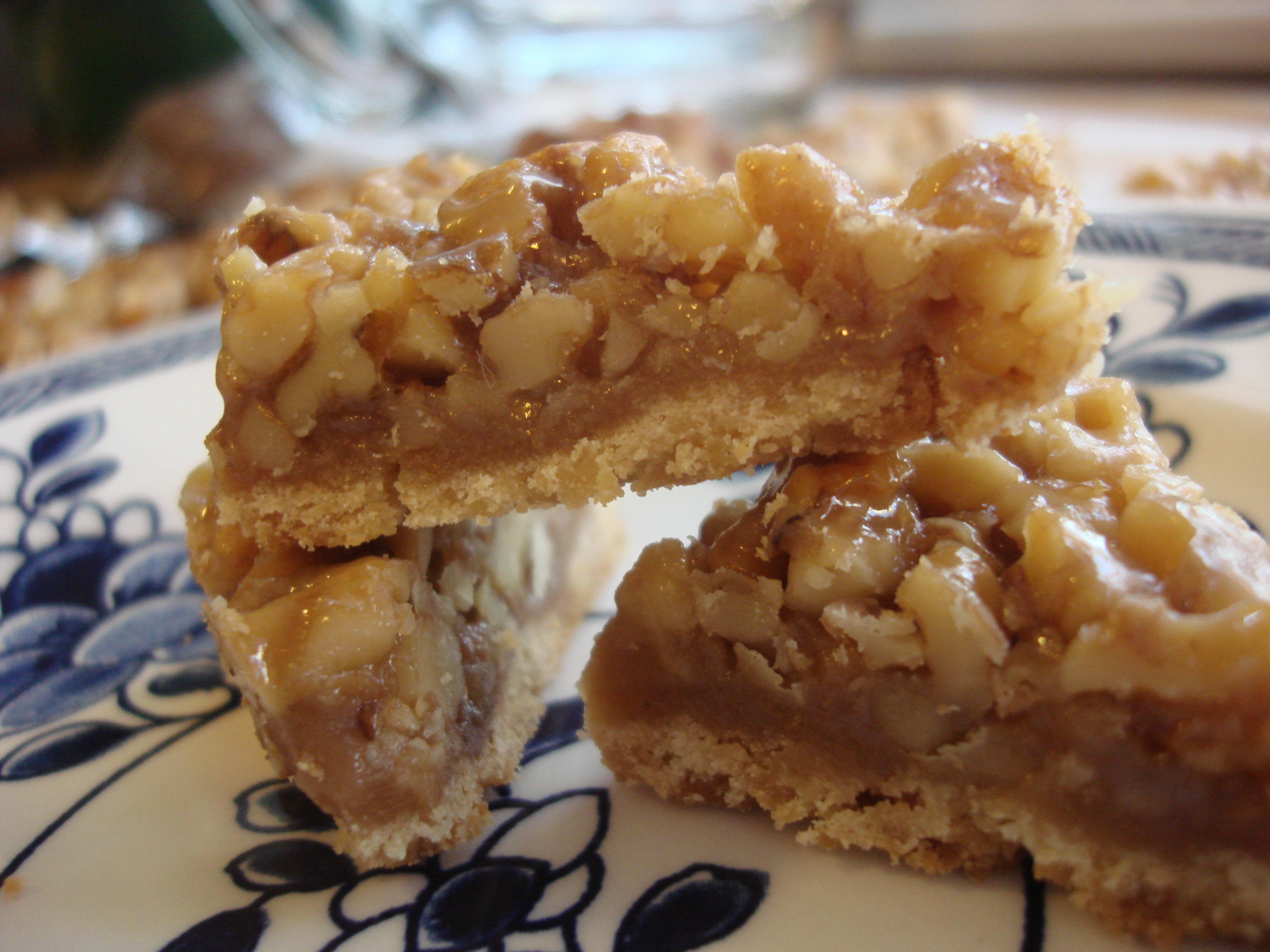
These Walnut Toffee Triangles were pretty easy to make (we did two batches in the oven at the same time; one tray for me and one for her), have a taste and texture reminiscent of baklava without the gooiness or Spanish turrón without the jaw-breaking stickiness. One batch gives you 4 dozen pretty and sophisticated little cookies AND they freeze beautifully, so if you pack them right, you can just pull a few out of the freezer anytime you need a rich dessert. And they are rich, just one or two will satisfy that need for a little something naughty with your coffee (or in my case, tea)!

So, if you are a busy, busy person (and who isn’t these days?), these triangles give you a lot of return for the time investment. And when you bake with friends, well, it’s that much better, isn’t it? Bring on the holidays!!!!

Walnut Toffee Triangles

(you need an electric mixer for this one)

Crust

½ Cup (1 stick) unsalted butter, softened

½ Cup packed light brown sugar

1 large egg yolk

1.5 Cups unsifted all-purpose flour

Topping

1 Cup packed light brown sugar

½ Cup (1 stick) unsalted butter

¼ Cup honey

½ Cup light cream

4 cups chopped walnuts

Preheat oven to 350°F.

Line bottom and sides of a 13x9x2 baking pan with aluminum foil, extending the ends of the foil beyond the two short pan sides.

Crust: In a medium bowl, with electric mixer on medium speed, beat butter until smooth and creamy. Beat in sugar and egg yolk until light and fluffy, 2-3 minutes. With mixer on low speed, beat in flour until mixture is smooth. (We didn’t find much difference between a worked dough and a less worked dough, so it’s up to you). Press mixture evenly into bottom of prepared baking pan. Bake 12-15 minutes.

Topping: While crust is baking, in medium saucepan over medium-high heat, combine sugar, butter and honey; heat until butter is melted. Bring to boil; let boil three minutes. Remove from heat. Stir in light cream and walnuts. Pour mixture evenly over prepared crust. Return to oven. Continue to bake for 19-21 minutes or until top is bubbling.

Cool completely in pan over wire rack. Lift foil by short sides and transfer bar to cutting board. Invert onto wire rack; carefully remove foil. Reinvert bar onto cutting board. Cut crosswise into ten equal strips. Cut each strip crosswise diagonally into five equal triangles (4 dozen cookies).

Mango Tango Salsa!

16 Nov

It was almost too late for that poor mango, bought in a frenzy of nostalgia for the tree my grandmother planted in her backyard in Mayagüez, a Puerto Rican town celebrated for its delicious, juicy, juicy, sweet, meaty, fiber-free mangos. In June, those suckers drop out of the sky and plop heavily onto the ground where you have to get them before the other critters do. They fall in such quantities that I spent many mornings cutting, slicing, peeling and freezing – you can’t possibly eat them all as they ripen. Friends in San Juan used to love to see me arrive with freezer bags full of Mayagüez mangos; they’d have the blender, booze and ice ready for action before I could even lock my car and get to the front door.

No such welcoming committee for this mango, even after its long journey from Brazil or Mexico or somesuch warm place, after its boring days in a chilly supermarket produce aisle next to a basket of equally foreign avocados, after too many days in the pale fall light of my southern exposure window, defended from attackers by its only company: several very busy spiders and a valiant Venus Flytrap. No, this poor mango was in dire need of attention and accessorizing, as its best days were behind it.

So, Mango Salsa it was, quick and dirty. Good excuse to eat blue corn tortilla chips, which are a weakness of mine (Waterloo to any attempt to get bikini ready) and to further prove that the Spanish love for fruit and cheese is grounded in pure genius and has infinite possibilities. The salsa sweet-tartness and the tortilla crunch just beg to be completed with some salty squeaky cheese – Queso Blanco (the firm kind of Latin white cheese) and Monterey Jack are my choices, but salted mozzarella would likely work also.

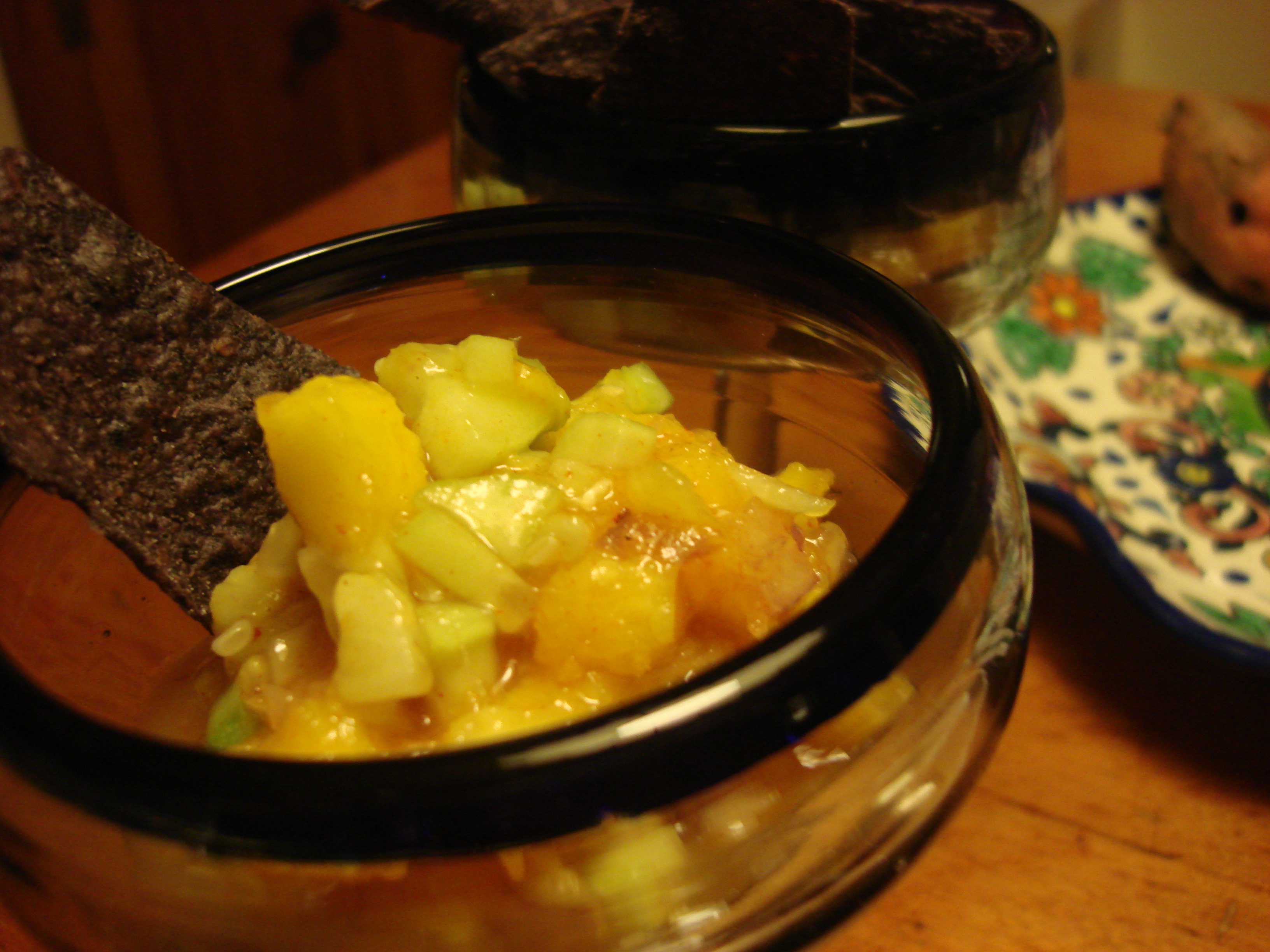
So here it is – a one bowl operation, served up in a margarita glass, a neglected mango finally loved up the way it should be.

Mango Tango Salsa

1 cup mango, chopped into small chunks*

1 cup cucumber, peeled, seeded (or not) and chopped into small chunks

3 Tbs red onion, minced

1 Tbs mango-orange juice (or mango or orange)

2 tsp chipotle in adobo paste (spoon it off the chipotles, but don’t include the peppers themselves)

3 tsp freshly squeezed lime juice

1 pinch salt

Put all ingredients into a small bowl. Mix thoroughly, add seasonings to taste, cover and refrigerate until chilled. Serve with sliced Caribbean white cheese, salted mozzarella or Monterey Jack and tortilla chips.

* To cut up a mango, hold it on its side lengthwise on a cutting board and choose a spot about a third of the way in. You want to slice down on either side of the seed so you have two bowls.  Score the flesh of each bowl like a checkerboard and turn it inside out (we call this a porcupine). Slice off the chunks and dice as needed. Yo can also cut flesh off the seed (or just eat the flesh off the seed yourself- you are the cook after all and deserve the treat!)

Ahead of the Holidays: Simple Clean and Green Kitchen Tips (from ewg.org)

15 Nov

I sometimes avoid reading suggestions on greening my kitchen — or indeed, my life — because they make it seem like everything I touch, clean or consume is bad for me and my family. The cumulative terror, frustration and exasperation (as well as the time, energy and money suck) is just overwhelming and often results in paralysis rather than action.

Having said that, the Environmental Working Group does have some good suggestions, backed up by research, and spooned out in easily-digested, non-toxic (haha) portions that are not so bad going down.

In honor of the impending holidays (and, apparently, in honor of a new fund-raising deal they have with amazon – brace yourself for some product placement) Environmental Working Group has posted tips for a safer, more environmentally friendly kitchen. It is short, sweet and fairly easily incorporated into your life.

Hope you find them useful!