Archive | June, 2011

I Want Your Stories!

13 Jun

I am working on a piece about the current generation of gardeners (specifically for edibles: fruit and veg) and I would love to hear your stories. When did you begin to garden? Why did you start? Why do you do you continue to do it? Is this your first try? Please comment here and let me know whether you mind being contacted about your gardening stories for possible publication…

Thanks! Natalia


Ensalada de Lentejas (Lentil Salad, Spanish-style)

11 Jun

The hot, hazy and humid summer weather typical of Long Island has started early this year, but that doesn’t mean I am giving up my lentils. I like the taste, the price and the fact that, unlike many of the other legumes, they don’t need pre-soaking.

Nutritionally these tiny almost-beans, almost-peas are giants. According to the Mayo Clinic’s Katherine Zeratsky, R.D., L.D., “…lentils are high in protein and fiber and low in fat, which makes them a healthy substitute for meat. They’re also packed with folate, iron, phosphorus, potassium and fiber.” So hip-rah, hip-rah! You should always, always, always have lentils in your pantry.

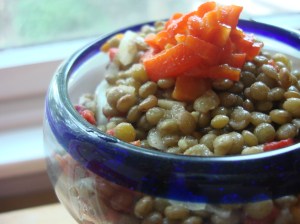
In winter I make hearty lentil soup, but hot weather calls for something cooler and lighter. I use a recipe — inspired once again by Penelope Casas’ The Foods and Wines of Spain. Have it as a main course with boiled potatoes or rice, or pair it with grilled sausages (from andouille to kielbasa..lentils love a good sausage partner). Lentils also marry well with grilled fish steaks; you can use the lentils as a bed, perhaps accompanied with polenta. This serves four as a side dish; you may want to double it for a BBQ accompaniment or main course.

Lentil Salad

½ lb uncooked pardina lentils (smaller and cuter than your average lentil, but you are free to substitute*)

1 onion, peeled. Cut in half, leaving one half whole and mincing the other half

1 clove

1 bay leaf

1 carrot scraped or peeled (scraping helps maintain a brighter color)

3 cloves garlic, peeled and smashed

1/8 tsp salt (a fat pinch)

Freshly ground pepper

¼ cup good olive oil

1.5 Tbs red wine vinegar

1 clove garlic, minced

 2 Tbs drained and minced roasted red pepper from a jar, plus 1 Tbs chopped for garnish

Rinse and pick through lentils and place in a large pot with enough cold water to cover. Stick the clove in the onion half (reserve the minced onion), then add to pot with bay leaf, carrot, smashed garlic, salt and pepper. Bring to a boil, cover and lower heat to a simmer and cook for 20-25 minutes, until just tender (longer if using regular green lentils). Drain and rinse well in cold water. Remove onion (and any clove that has fallen out), bay leaf and garlic. Dice carrot and place in serving bowl with lentils. Add olive oil, vinegar, reserved mined onion, chopped garlic and minced red pepper and mix gently (you don’t want the lentils to fall apart). Let rest for at least a half hour and serve, topped with reserved red pepper as garnish.

*Green lentils are great for salads because they keep their texture. Brown can get mushy and red lentils fall apart when cooked too long, If you choose them as substitutes, start checking the texture after 15 minutes of simmering.

¿Que qué? ¡Quesadillas! (Camp stove friendly)

9 Jun

Finger food supreme

One day I will be an eater of sandwiches.

But for now aside from the odd grilled cheese, I am not a sandwich girl. Just don’t like all the bread, the sliced deli meats, cold salads inside…I just don’t get it. Unless of course it is a pressed Cuban sandwich, con todos los poderes, de Elegguá pa’bajo…you know, like real bread, toasted, mad quantities of stuff, greased up…I can do that. In Miami. Or San Juan de Puerto Rico (ah, Kasalta). Occasionally.

But not being a sandwich person in this American life is to miss out on a lot of convenience and portability. So, I have discovered the quesadilla. Take whatever you’ve got in the fridge, spread it over half of a tortilla toasting in a skillet, sprinkle melty cheese, fold it, flip it, and allí está…a sandwich worth eating. Slice it like a pizza and you can dip it into hot sauce too.

It worked very well on our camping trip. Leftover black beans, some Monterrey Jack and sriracha and go, baby, go. Other things I have stuffed into quesadillas include pollo guisado; cheddar cheese and tomato slices; leftover sliced steak; roasted vegetables; sundried tomato and smoked mozzarella…all awesome and all done in no time, sealed with a kiss of cheese. You can slip avocado in the middle where it won’t get hot to give a lovely creaminess (plus health benefits, I am sure, but who cares?)

Quesadillas (with your choice of stuffing)

1 package of large soft tortillas (flour or corn)

a spritz of cooking oil on a good iron skillet or nonstick

1-2 cups filling (LEFTOVERS! cooked beans, cooked veg, stewed meat, sliced cooked meat)

couple of fistfuls shredded meltable cheese

1-2 Tbs herbs/hot red pepper flakes/salsa – it’s up to you to make the matches

Heat the skillet and the oil to medium. Lay a tortilla on it. Cover half with filling (Not too thick! Maybe 1/4 inch – you don’t want a mess). Sprinkle cheese (especially around the edge to make a seal). Fold the empty tortilla half over. Allow to cook a minute, then flip with fingers if you are daring, or a spatula. Turn a few times until a bit crispy and transfer to a plate. Start again with another tortilla. You can slice into wedges and serve with whatever condiments go with your filling.

Farm and chicken update (and new poll!)

7 Jun


We headed over to Restoration Farm, our CSA, today to put in a little work and visit the chickens.

Leandro was a champion snap pea picker (he remembered his skills from last year) on this bright sunny day that showed hints of what a sweltering hazy, hot and humid Long Island summer can be.

Many peas didn’t make it to the basket, as they ended up in his mouth. He won’t yet eat the pods, preferring to open them up and eat the tiny peas inside, edamame-style. It’s a start. And at least he knows they grow on vines, not exclusively in the frozen food section! Mommy gets the pods, which are wonderfully crunchy and bright.

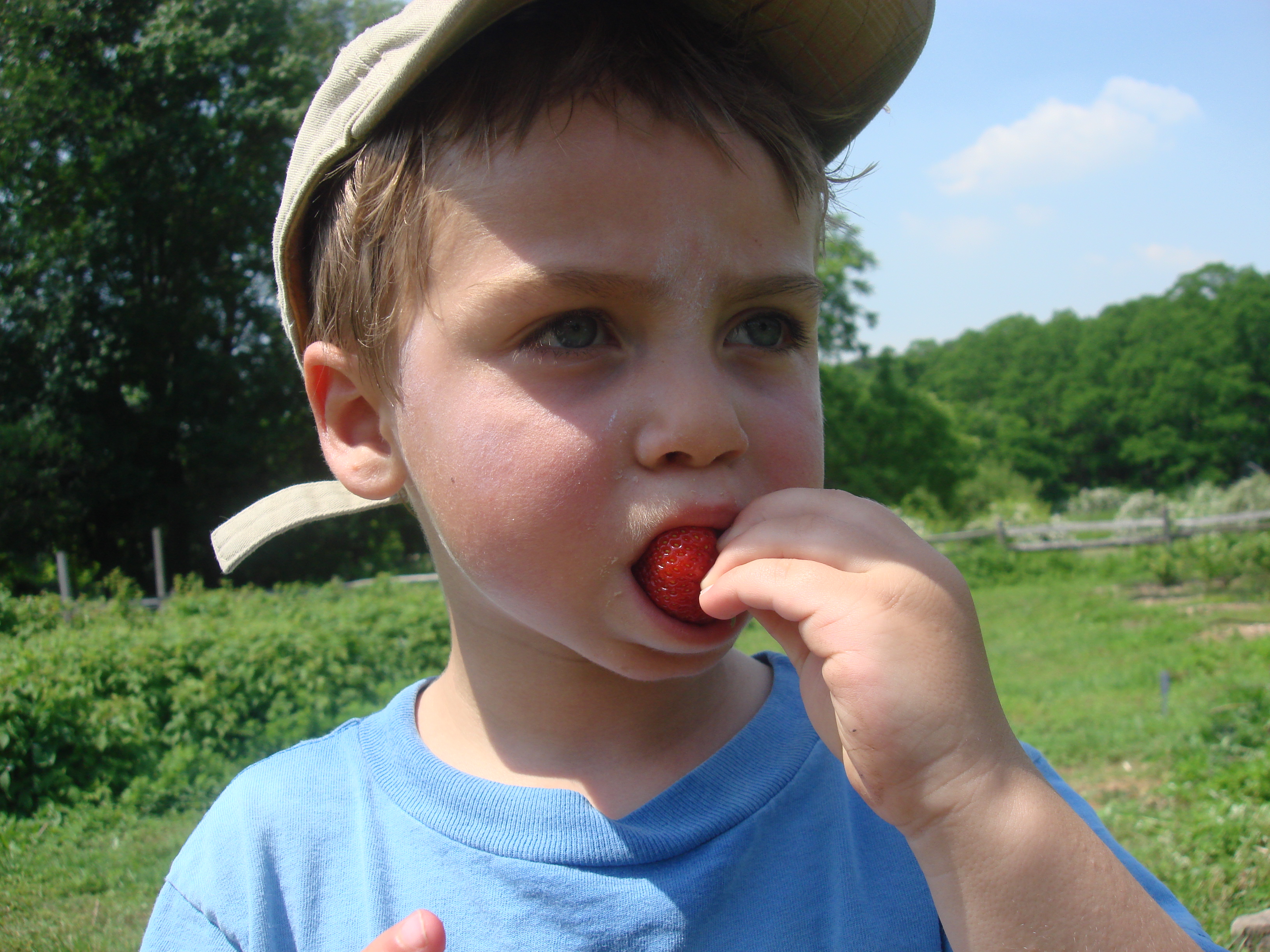
The boy was also introduced to the delights of picking strawberries, but won’t get a chance to pick his own quart until our pick-up day, later this week. Whether any berries he picks will actually end up getting home is doubtful. I will have to make sure he doesn’t get out of hand. He can devour a pound of strawberries at a sitting and since they are amongst the most chemical-laden of fruits when conventionally-grown (see http://ewg.org/) and very expensive to buy organic, I hope this is a good year for strawberries in our neighborhood!

We visited the chickens, of course. He still loves Donna’s future egg-layers and their roving chicken coop (now painted a proper barnyard red), but the now five-week-old eating birds, not so much.

“Ew! Stinky!” is all I got out of him today, as he ran away to see what he could spirit out of the berry patch. As we get closer to our first installment of locally pastured chickens, I am starting to think about what irresistible dish to concoct for him….


Better Scrambled Eggs (another campsite cooking fave)

6 Jun

Rustic and Righteous

I love scrambled eggs anytime (and that includes lunch and dinner), but as a camping breakfast they are especially delicious (and quick and easy).

We managed to find some terrific organic eggs at a supermarket during our week out in Montauk; if you keep your eyes sharp in farm country, there is usually a farmstand that has something fresh and local.

You can tell an egg is very fresh if: 1) it stays completely on the bottom of a pot of water and 2) if the yolk is rounded (not flat) when you crack it open. IMPORTANT: If one end of the egg floats up it is quite edible, but less than fresh. If the whole thing floats, it’s rotten. While camping, eggs that are kept chilled will keep for about five days. And white eggs and brown eggs have no appreciable difference in nutritional value; some breeds lay brown eggs; some lay white. Brown eggs just look more virtuous and granola-y.

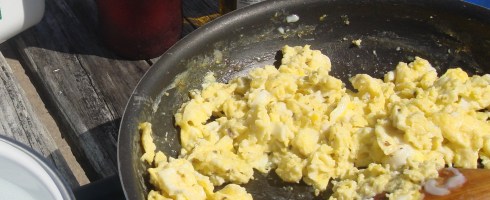
Here, the addition of herbs and cheese makes a plain egg breakfast memorable.

Scrambled eggs with herbs and cheese

(figure on 2-3 eggs per person, depending on appetites and whether you have accompanying bread/toast. If cooking more eggs, do not increase the oil and be scanty when you increase the milk)

1/2 Tbs olive oil

6 eggs

1 Tbs milk

1 tsp dried herbs (2 tsp if using fresh) I prefer straight oregano, but have also been charmed by Provencal-type blends. Thyme is lovely, as is parsley.

1/8-1/4 tsp salt (two pinches should do)

1 Tbs grated grana padano or parmigiano reggiano

Whisk (fork is fine) eggs lightly with milk and salt in a bowl. Heat the oil in a skillet until fragrant (a nonstick may need less oil). Pour in the eggs and lower heat. As  the egg mixture solidifies, sprinkle herbs and cheese evenly over. Then, gently drag a spatula over the mixture occasionally as the bottom cooks. Cook to your preference, moist or dry and serve, with bread if you’ve got. Bacon is probably an obvious accompaniment, but on my minimalist camping menu that wasn’t happening. Campers can also serve with prosciutto or a cured sausage and a handful of grape or cherry tomatoes.

Aglio, Olio e Peperoncino (adapted for campsite family meals)

5 Jun


Disclaimer: This is in no way an authentic version of the Roman classic dish of spaghetti with garlic, oil and hot red pepper flakes. I have lived in Italy, I have had (and made) the real aglio- olio….and it is sublime in its balance and simplicity. I am not trying to improve on perfection. I am just adapting it to my imperfect life!

My adaptation is also pretty sublime, simple and balanced, but it is definitely not the original. So with apologies to Patrizia and Sandro (whose agonized “No!” when he saw me add cheese to the dish once still reverberates in my head) and any other Roman who happens upon this recipe…here we go!

This is a version that I cooked up in 15 minutes this week at a windy beachside campsite on a propane camp stove for me and my pre-K camper (who has just — thank heavens — made the breakthrough to spicy food). So convenient and successful, I made it twice over the week. I also sometimes add broccoli crowns to the pasta water when there are about four minutes left in the boil

Aglio, olio e peperoncino (adapted for camping)

The classic Roman versión uses spaghetti, but that is currently too messy for my kid. I like a tube-y or curly pasta. For the purposes of our camp kitchen I used three-minute rotini – a pasta that boils up in three minutes. It is decidedly flabby compared to regular pasta, but was adequate for the less fussy camping life. I actually prefer Bionaturae’s organic whole wheat pastas in this dish; they add a nutty flavor that I like very much. This is also a one pot dish (except for the colander) which is great when you haven’t got running water!

Serves two, but is quite easy to double up

½ lb pasta of your choice (preferably spaghetti or something long and lean rather than scoopy. If you choose the broccoli option, penne is a good choice)

(one or two handfuls broccoli florets; optional)

2 Tbsp extra virgin olive oil

3 cloves garlic, minced

1/8 to ¼ tsp hot red pepper flakes

1/4 cup grated grana padano or parmigiano reggiano

Boil the pasta according to package instructions, making sure to salt the water well. If using broccoli, add to the pasta water 3-4 minutes before the pasta is fully cooked. Drain and reserve in a separate bowl or the colander. In the same pot that you cooked the pasta, add the olive oil, lowering heat to medium. When the olive oil is loose and fragrant, add the garlic and red pepper flakes (to taste) and stir around until the garlic is golden (not brown). Add the pasta (and broccoli) back to the pot and mix well, adding grated cheese. Serve!